Egg Binding In Hens: Symptoms, First Aid And When To Call A Vet
If one of your hens is egg bound, it means an egg is stuck in her reproductive tract and she cannot lay it normally. Egg binding in hens is something you need to take seriously, but try not to panic.
A hen that keeps visiting the nest box or stands in an unusual position is not necessarily egg bound. Broodiness, constipation, a prolapse and several internal laying problems can all cause similar symptoms. The important thing is to look at your hen’s overall behaviour, not just one sign.
If she is repeatedly straining, walking strangely, becoming weak or sitting apart from the flock, move her somewhere warm and quiet and contact a poultry or avian vet for advice. Do not squeeze her abdomen or try to pull, break or push the egg out yourself.
What should you do straight away?
When you are worried about one of your hens, it is easy to start searching online and trying one home remedy after another. With possible egg binding, keeping things simple is usually safer.
You should:
- Move your hen away from the flock.
- Keep her somewhere warm, quiet and free from draughts.
- Put fresh water within easy reach.
- Check the outside of her vent for blood, swelling, discharge or protruding tissue.
- Contact a poultry or avian vet for same-day advice.
If your hen is collapsing, bleeding, struggling to breathe or has pink or red tissue coming out of her vent, treat it as urgent.
What does egg binding mean?
An egg normally travels down your hen’s oviduct before passing through the cloaca and vent. Egg binding happens when the egg becomes stuck somewhere along the way.
The egg may be:
- Larger than usual
- Double-yolked
- Misshapen
- Soft-shelled
- Positioned incorrectly
A large, hard-shelled egg may simply be too difficult for your hen to pass. A soft-shelled egg can also cause trouble because it bends and folds instead of moving forwards easily.
Some hens do eventually lay a difficult egg by themselves. The problem is that you cannot know whether your hen will do this safely or whether her condition will get worse.
A stuck egg can put pressure on her internal organs, make it difficult for her to pass droppings and cause repeated straining. In more serious cases, it can lead to a prolapse, damage to the oviduct or infection.
What are the symptoms of egg binding in hens?
You may notice your hen:
- Going in and out of the nest box without laying
- Sitting in the nest box for much longer than usual
- Straining or repeatedly moving her tail up and down
- Standing with her body very upright
- Walking with short steps or a penguin-like stance
- Sitting alone or hiding away from the flock
- Fluffing up her feathers
- Closing her eyes or looking sleepy
- Eating or drinking less than usual
- Passing fewer or smaller droppings
- Producing watery droppings
- Developing a swollen or dirty vent
- Suddenly stopping laying
- Becoming weak or unsteady on her feet
In my experience, changes in behaviour are often the first thing you notice. You know what is normal for your own hens. If one of them suddenly stops following the flock, loses interest in food or keeps returning to the nest without laying, it deserves a closer look.
That does not necessarily mean she is egg bound, but it does tell you that something is wrong.
You can read more about the wider signs of illness in How To Tell If A Chicken Is Sick.
Can you feel the egg inside your hen?
Sometimes you may be able to feel a firm, egg-shaped object low down in your hen’s abdomen, close to the vent. However, you should not rely on this as a way of diagnosing egg binding.
A soft-shelled egg may not feel firm at all. An egg that is higher up the reproductive tract may also be impossible to feel. There is also a risk that you could mistake swelling or another internal problem for an egg.
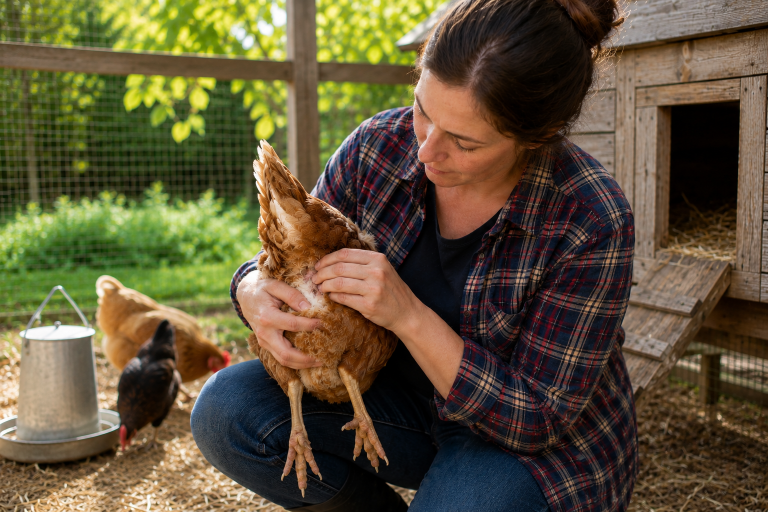
If you do examine your hen, handle her gently and avoid pressing on her abdomen. Never squeeze her in an attempt to move the egg. You could crack it or injure the reproductive tract.
A vet may use an examination, X-ray or ultrasound to find out whether there is an egg and exactly where it is.
Could it be something other than egg binding?
This is one of the most important points to understand. Several common chicken health problems can look very similar to egg binding.
Prolapse
A prolapse happens when tissue from inside your hen’s cloaca or reproductive tract protrudes through the vent. You will usually see moist pink or red tissue. There may also be blood.
Egg binding and prolapse are not the same thing, although repeated straining to pass an egg can cause a prolapse.
If you see protruding tissue, separate your hen from the flock straight away. Other chickens may peck at it and cause severe injuries. Keep the tissue clean and moist with sterile saline if you have it, then seek urgent veterinary help. Do not keep pushing the tissue back inside without veterinary guidance.
Broodiness
A broody hen can spend nearly all day in the nest box, puff up her feathers and become rather cross when you approach her. The difference is that a broody hen is normally alert and strong. When she leaves the nest, she should be able to walk normally, eat, drink and pass a large dropping. A broody hen should not be repeatedly straining, collapsing or standing like a penguin.
Constipation or a digestive blockage
If your hen is passing very few droppings, it is easy to assume that she is constipated. However, an egg can press against the cloaca and make it harder for droppings to pass. Your hen may also produce less waste simply because she has stopped eating.
Do not give oil or laxatives unless a vet has advised you to. Giving liquid directly into a chicken’s mouth can cause it to enter the airway.
Internal laying or egg yolk peritonitis
Internal laying and egg yolk peritonitis can cause a swollen abdomen, wide stance, reduced laying, breathing problems and loss of appetite. These signs can look very similar to egg binding. You may not see the repeated nest-box visits or active straining that often happen when an egg is stuck.
Unfortunately, you cannot reliably tell these conditions apart by feeling your hen’s abdomen. Veterinary examination is usually needed.
A soft-shelled egg
Your hen may be trying to pass an egg that has little or no shell. These eggs are much harder for the muscles of the oviduct to move because they bend instead of staying firm. You may see pieces of membrane, egg white or yolk around the vent.
A soft-shelled egg can still become stuck and should not be treated as a minor problem if your hen is distressed.
Our guide to soft-shelled eggs explains why they happen and what repeated soft eggs can tell you about your hen’s health.
How can you help an egg-bound hen?
The safest first aid is supportive care. Your aim is to keep your hen calm, comfortable and stable while you speak to a vet.
Move her somewhere quiet
Place her in a clean pet carrier, dog crate or small indoor pen.
Put a towel or another non-slip covering on the floor. This will help her keep her balance and make it easier for you to see whether she passes any droppings, egg material or discharge.
I prefer to keep an unwell hen somewhere close enough that I can check her regularly without constantly handling her. You will learn more by watching how she stands, breathes and responds than by repeatedly picking her up.
Keep her comfortably warm
An unwell hen can lose body heat quickly, especially if she is sitting still. Keep her in a warm room away from draughts. Gentle background warmth is usually enough.
Do not place her directly on a very hot water bottle or heat pad. She should always be able to move away from the heat. If she starts panting or holds her wings away from her body, she is too hot.
Give her easy access to water
Place a small, stable drinker close to her so that she does not have to walk or stretch. Do not pour water into her beak. Chickens can easily inhale liquid into their lungs.
You can offer a little of her normal layers feed, but do not force her to eat.
Check the outside of the vent
Put on a pair of disposable gloves, gently lift the tail feathers and look at the outside of the vent.
Check for:
- Blood
- Pink or red protruding tissue
- Swelling
- A visible egg
- Broken shell
- Egg membrane
- Discharge
- Heavy soiling
Do not insert your finger, tweezers or any other object into the vent.
If you keep chickens, it is useful to have gloves, clean towels and sterile saline ready for situations like this. You can find a practical list in our chicken first aid kit guide.
Should you put an egg-bound hen in a warm bath?
Warm baths are one of the most commonly suggested treatments for egg binding. The idea is that warmth may help your hen relax.
The problem is that a bath does not remove a physical obstruction. It can also stress a weak hen and leave her chilled if she is not dried thoroughly.
Personally, I would start with a warm, quiet carrier rather than putting an already unwell hen through repeated baths.
If your vet recommends a bath, use shallow warm water, support your hen throughout and make sure she is completely dry before returning her to her carrier.
Epsom salts are not a proven treatment for egg binding. You do not need to add them to the water unless your vet specifically advises it.
What should you avoid doing?
When your hen is struggling, it is understandable that you want to do something immediately. Unfortunately, some of the most common online suggestions can make the situation worse.
Do not:
- Squeeze or firmly massage your hen’s abdomen
- Try to push the egg towards the vent
- Pull on an egg that you can see
- Crack or puncture the egg yourself
- Insert fingers or tools into the vent
- Pour cooking oil into her beak
- Put oil or cream deep inside the vent
- Give human painkillers
- Use antibiotics or other medicine left over from another hen
- Keep trying one home remedy after another while she deteriorates
A vet may sometimes remove or collapse an egg, but this is done carefully and may require pain relief, sedation or anaesthesia.
Trying to copy the procedure at home can leave sharp pieces of shell inside your hen or tear the oviduct.
When should you call a vet?
You should contact a poultry or avian vet the same day if you reasonably suspect egg binding.
There is plenty of advice online telling keepers to wait 24 or 48 hours. I would not rely on those time limits. One hen may remain stable for several hours while another becomes seriously ill much more quickly.
Seek urgent help if your hen:
- Cannot stand
- Keeps falling over
- Is struggling to breathe
- Is breathing with her beak open
- Has a pale, grey or bluish comb
- Is continuously straining
- Has blood around the vent
- Has an egg visibly stuck
- Is passing broken shell or egg material
- Has tissue protruding from the vent
- Has a very swollen abdomen
- Is becoming less responsive
- Is rapidly getting weaker
When you call the vet, tell them:
- When your hen last laid an egg
- When you first noticed the symptoms
- Whether she is eating and drinking
- Whether she is passing droppings
- Whether you have seen blood, discharge or prolapsed tissue
- Whether she has recently laid soft, large or misshapen eggs
This information will help the practice judge how urgently she needs to be seen.
If your normal vet does not treat chickens, you can use the RCVS Find a Vet service to look for a suitable practice.
What will the vet do?
Your vet will first check your hen’s general condition, breathing, hydration, abdomen and vent.
If the egg cannot be found easily, they may suggest an X-ray or ultrasound. This is particularly useful when the egg is soft-shelled or when another reproductive condition could be causing the symptoms.
Depending on what they find, treatment may include:
- Fluids
- Pain relief
- Calcium
- Medication to help the oviduct contract
- Lubrication
- Careful removal of the egg
- Treatment for a prolapse
- Sedation or anaesthesia
- Surgery in severe cases
Calcium can be useful in some cases because it is involved in muscle contractions as well as shell formation. However, this does not mean that every egg-bound hen simply needs a calcium tablet.
The correct treatment depends on why the egg is stuck and how ill your hen has become.
What causes egg binding?
Egg binding does not always have one clear cause.
Possible risk factors include:
- An unusually large egg
- A double-yolked egg
- A soft or shell-less egg
- A misshapen egg
- Poor muscle contractions
- An unbalanced diet
- Calcium deficiency or poor calcium absorption
- Obesity
- A young hen laying her first eggs
- Previous prolapse or reproductive injury
- Infection or inflammation in the oviduct
If your hen has laid one unusually large egg, it may be a one-off problem. Repeated soft, misshapen or oversized eggs are more concerning and should be investigated.
Can you prevent egg binding?
You cannot prevent every case, but good feeding and flock management can reduce some of the risks.
Feed a complete layers ration
Your hens’ main food should be a complete layers pellet or mash. Too much corn or other treats can dilute the balance of protein, calcium, vitamins and minerals.
Offer a separate calcium source
Give your laying hens access to soluble oyster shell in a separate container. Your hens can then take additional calcium when they need it. Flint grit serves a different purpose and does not replace oyster shell.
You can read more in How To Tell If Your Chickens Are Getting Enough Calcium.
Keep an eye on their weight
Overweight hens are more likely to develop reproductive problems.
You may not notice gradual weight gain beneath all those feathers, so it helps to handle your hens occasionally and become familiar with how their breastbone and body condition normally feel.
Watch for changes in the eggs
Do not ignore repeated soft, thin-shelled, oversized or misshapen eggs.
One strange egg is often nothing to worry about. A pattern of abnormal eggs may tell you that your hen needs dietary changes or a veterinary check.
A sudden stop in laying is not always egg binding either. Moulting, broodiness, age, short winter days, stress and illness can all reduce egg production. Our guide to why chickens stop laying eggs explains the most common reasons.
Frequently asked questions
How long can an egg-bound hen survive?
There is no safe answer that applies to every hen.
Some hens may pass the egg after a period of rest, while others can deteriorate quickly. Much depends on where the egg is stuck and whether it is blocking the cloaca or damaging the reproductive tract.
Do not wait for a fixed 24-hour or 48-hour deadline before seeking help.
Can an egg-bound hen still poo?
Yes. Your hen may still pass small or watery droppings if the egg is only partly blocking the cloaca. However, passing droppings does not prove that she is not egg bound.
Can she lay the egg herself?
She may do. Some hens pass a difficult egg once they are somewhere quiet and warm. The difficulty is that you cannot know whether your hen will improve or continue to weaken. That is why you should still speak to a vet.
Should you give her calcium?
Your hens should normally receive calcium through a balanced layers feed and a separate source of oyster shell.
A vet may give calcium as part of the treatment for egg binding, but you should not guess the dose using human supplements. Calcium will not remove an egg that is physically wedged in the reproductive tract.
Can you use oil?
Do not pour cooking oil into your hen’s beak. There is a risk that she could inhale it. You should also avoid pushing oil deep into the vent. A vet may use a suitable lubricant during an examination, but oil is not a cure for every case of egg binding.
Does a prolapse mean there is still an egg inside?
Not necessarily. A prolapse can appear after an egg has already been laid. It can also be caused by repeated straining or another reproductive problem.
Because a stuck egg and a prolapse can happen together, you should seek urgent veterinary help whenever you see protruding tissue.
Final thoughts
Egg binding is one of those problems where you need to act promptly without panicking.
If your hen is repeatedly straining, standing upright, walking strangely or becoming quiet and weak, move her away from the flock, keep her warm and offer water.
Then speak to a vet.
You know your own hens better than anyone. If one of them suddenly looks or behaves differently, trust that instinct and investigate. I would always rather make an early phone call and be told to keep watching than spend hours trying home remedies while a hen gets worse.
Sources and further reading
- MSD Veterinary Manual: Egg-Bound or Impacted Oviducts in Poultry
- MSD Veterinary Manual: Common Management-Related Problems in Backyard Poultry
- British Hen Welfare Trust: Prolapse
- VCA Animal Hospitals: Egg Binding in Birds
Disclaimer: This article provides general information for chicken keepers. It is not a substitute for examination, diagnosis or treatment by a qualified veterinary surgeon.
Affiliate disclosure: This article may contain affiliate links. If you buy something through one of these links, I may earn a small commission at no extra cost to you. Any products mentioned are secondary to the health advice given and are included only where they may be genuinely useful.

Kevin O’Hara got his first chickens back in 1972. A backyard chicken keeper based in Yorkshire, he created of KeepingChickens.uk back in 2012. With years of hands-on experience, he shares practical, UK-specific advice to help others care for happy, healthy hens. Learn more about Kevin on the author page.