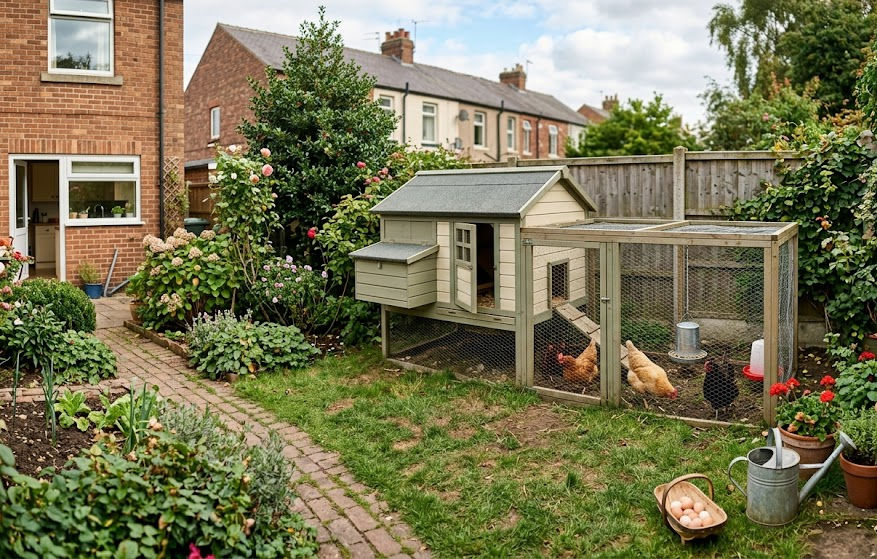
Best Chicken Coops For Small UK Gardens: 5 Compact Options
The best chicken coops for small UK gardens make efficient use of limited space without compromising cleaning, ventilation, security or flock welfare. A compact coop can work well for two or three hens, but manufacturer capacity claims and tiny integrated runs need careful scrutiny. This guide compares five currently available options and explains which type of keeper, flock and garden each one suits.
Key takeaways
- The Omlet Eglu Go is the strongest all-round choice for easy cleaning and low maintenance.
- The Green Frog Designs Small Chicken House is a practical recycled-plastic alternative.
- The Cocoon ECO 1500 provides a compact house and covered run, but hens will need additional daytime space.
- The Kerbl Emma suits keepers who prefer a traditional wooden house and already have a secure run.
- The Aivituvin AIR67 is the best option here if moving the coop around the garden is important.
- Do not rely on advertised capacity alone. Breed size, ventilation, perch space and run access all affect how many hens a coop can accommodate comfortably.
How I selected these small chicken coops
I looked beyond overall dimensions and the number of hens stated in each Amazon listing. A small footprint is useful, but it does not compensate for poor access, inadequate ventilation or an impractical cleaning arrangement.
Each shortlisted coop was assessed against the following criteria:
- Realistic capacity for standard hens or bantams
- Total garden footprint
- Cleaning and inspection access
- Nesting and perching arrangements
- Ventilation
- Predator resistance
- Materials and weather protection
- Maintenance requirements
- Availability through Amazon UK
- Suitability for a separate or extended run
I have not treated manufacturers’ maximum capacities as targets. Chickens may only sleep and lay in the enclosed house, but they still need enough room to perch comfortably, move around and avoid excessive heat, moisture and ammonia.
The recommended capacities below are therefore deliberately cautious.
Best small chicken coops compared
| Chicken coop | Approximate dimensions | Realistic capacity | Run included? | Best for |
|---|---|---|---|---|
| Omlet Eglu Go | 78 × 75 × 59cm, house only | 3 standard hens or 4 bantams | Optional | Best overall |
| Green Frog Designs Small Chicken House | 116 × 106 × 100cm | 3 standard hens or 4 bantams | No | Recycled-plastic construction |
| Cocoon ECO 1500 | 150 × 70 × 93cm | 1–2 standard hens or 3 bantams | Yes, compact covered run | Small starter setup |
| Kerbl Emma | 146 × 74 × 85cm | 2–3 standard hens | No | Traditional wooden housing |
| Aivituvin AIR67 | Approximately 170 × 102 × 126cm | 2–3 standard hens | Enclosed lower area | Mobile setup |
Dimensions should always be checked against the current listing before ordering because bundles and retailer specifications can change.
Omlet Eglu Go: best overall small chicken coop

Omlet Eglu Go Chicken Coop
Compact, easy-clean plastic housing for up to three large hens or four bantams, with a design well suited to small UK gardens.
The Omlet Eglu Go is my strongest all-round recommendation for a small garden. Its enclosed house occupies a relatively modest area, yet Omlet rates it for three large hens or four smaller birds.
For me, its biggest advantage is not simply its size. It is the smooth, removable plastic interior. The rear panel can be opened for access, while the droppings tray and roosting bars can be removed for cleaning. Plastic also dries more quickly than timber and presents fewer deep cracks and joints in which red mites can hide.
The twin-wall design provides insulation, while fixed ventilation helps remove moisture without leaving hens exposed to a direct draught. Eggs can be collected through the rear access point, so you do not need to crawl into a run or lift a large roof panel.
A run is not automatically included with every Amazon package. Some listings cover the house alone, while others may include accessories. Check the exact bundle carefully before ordering.
Practical advantages
- Compact plastic house
- Removable tray and roosting bars
- Easy rear access
- Insulated twin-wall construction
- Low routine maintenance
- Optional matching runs and extensions
- Suitable for standard hens and bantams
Points to consider
The Eglu Go is low to the ground, so some keepers may prefer the raised Eglu Go Up. However, the raised model and its supporting frame take up more room.
The nesting area is integrated rather than fully separated. That should be adequate for a small flock, but it is less defined than the nest box in a larger traditional coop.
The standard attached run should not be regarded as generous all-day accommodation for the maximum number of hens. A longer run, walk-in enclosure or additional secure garden space will usually be needed.
Best suited to: Keepers who prioritise simple cleaning, low maintenance and compact plastic housing.
View the Omlet Eglu Go on Amazon UK (affiliate link).
Green Frog Designs Small Chicken House: best recycled-plastic coop

Green Frog Designs Small Chicken House
Durable recycled-plastic housing for a small flock, with removable sections that make cleaning and inspection easier.
The Green Frog Designs Small Chicken House is another strong plastic option. It is made from recycled plastic and is marketed for three large hens or four bantams, which seems reasonable for its intended use as sleeping and laying accommodation.
The removable rear panel, roof, nest box and wooden perch make it easier to reach areas that can be awkward in a small coop. This matters because compact housing can become unpleasant quickly when trays, corners and perch fittings are difficult to access.
The house measures approximately 116cm long, 106cm wide and 100cm high when the roof overhang, nest box and ramp are included. It requires more ground space than the Eglu Go, but it remains manageable in a modest garden.
Plastic construction removes the need for regular wood treatment. It should also be quicker to wash and dry than a wooden house, although bedding and waste still need to be removed before cleaning.
Practical advantages
- Recycled-plastic construction
- Removable roof, back panel, perch and nest box
- Fewer mite-friendly crevices than many wooden coops
- Carry handles for repositioning
- Single waterproof nest box
- Suitable for a small flock
Points to consider
This is a chicken house, not a complete house-and-run system. You will need to place it inside a suitably secure run or connect it to a protected enclosure.
The plastic panels may not appeal to keepers who want a traditional-looking wooden coop. However, I would put ease of cleaning and longevity ahead of appearance, particularly in a small garden where the coop sits close to the house and needs regular attention.
Best suited to: Keepers who want a durable, easy-clean plastic house without choosing an Omlet design.
View the Green Frog Designs Small Chicken House on Amazon UK (affiliate link).
Not sure how much room your flock needs? Read our guide to [how much space chickens need] before choosing a coop or run.
Cocoon ECO 1500: best compact coop with a covered run

Cocoon ECO 1500 Chicken Coop
A compact wooden coop with a raised sleeping area and covered run, best used with additional secure daytime space
The Cocoon ECO 1500 combines a raised sleeping area with a narrow covered run. At approximately 150cm long and 70cm wide, it can fit into spaces where a broad square coop would be awkward.
It includes a nest box, perches, a pull-out metal-lined cleaning tray and a roof that opens for access. An internal sliding door separates the sleeping compartment from the run, allowing the birds to be secured at night.
The fully covered lower section gives hens shelter from rain and provides a useful protected feeding or scratching area. However, it is important to be realistic about its limitations.
The attached run is not large enough to act as the hens’ only daytime space. I would regard the ECO 1500 as suitable for one or two small-to-medium hens, or up to three bantams, provided they have access to a larger secure enclosure during the day.
Practical advantages
- Narrow footprint
- House and covered run in one structure
- Metal-lined pull-out cleaning tray
- Opening roof
- Internal sliding night door
- Separate nest box and perches
- Sheltered area beneath the sleeping compartment
Points to consider
The timber will need routine inspection and protection from prolonged damp. Positioning the coop on a level, well-drained surface should help reduce deterioration around the base.
As with many flat-packed wooden coops, check every fastening, latch and mesh joint during assembly. I would not assume that a factory-fitted catch is automatically fox-resistant.
The run size is the biggest limitation. It provides useful temporary shelter, but keeping two or three birds permanently confined within the supplied footprint would not give them enough room to forage, exercise and avoid one another.
Best suited to: First-time keepers wanting a compact starter structure that will sit inside, or connect to, a larger secure run.
View the Cocoon ECO 1500 on Amazon UK (affiliate link).
Kerbl Emma: best traditional wooden chicken house

Kerbl Emma Chicken Coop
A traditional wooden hen house with nesting areas, perches and ventilation, designed for use inside a separate secure run.
The Kerbl Emma is a traditional timber hen house with a long, relatively narrow footprint. It measures approximately 146cm by 74cm and includes two nesting areas, perches and a sliding ventilation window.
The raised sleeping section helps separate the birds from cold or damp ground. Its folding bitumen-covered roof also provides useful access for cleaning and inspection.
Although some retailers suggest much higher flock capacities, I would limit it to two or three standard hens. This gives them more realistic perch and sleeping space while reducing pressure on ventilation and bedding.
The Emma has a side opening that can be connected to a separate enclosure. That makes it more suitable for a garden where a secure run is already in place or will be built around the house.
Practical advantages
- Traditional appearance
- Narrow footprint
- Two laying nests
- Perches included
- Adjustable sliding ventilation window
- Raised sleeping and nesting area
- Folding roof for access
- Compatible with a separate run
Points to consider
Wooden coops require more maintenance than recycled-plastic alternatives. The timber should be protected with a poultry-safe treatment, particularly around exposed edges and areas close to the ground.
Wood joints, roof edges, nest boxes and perch fittings also need regular red-mite inspections. A wooden coop can serve a flock well, but only when the keeper is prepared to clean, dry and maintain it properly.
I would also examine the roof, hinges and catches closely during assembly. Flat-packed timber can move slightly as it becomes wet and dries, so doors may need occasional adjustment.
Best suited to: Keepers who prefer a conventional wooden coop and have room for a separate secure run.
View the Kerbl Emma Chicken Coop on Amazon UK (affiliate link).
Aivituvin AIR67: best mobile coop for a small flock

Aivituvin AIR67 Chicken Tractor
A movable wooden coop with wheels, nesting space and an enclosed lower area for a small garden flock.
The Aivituvin AIR67 is the largest option in this comparison, but it offers something the others do not: substantial wheels designed to help move the structure around the garden.
Moving a coop can reduce repeated damage to one patch of ground and give hens access to fresh areas. It can also make cleaning around and beneath the house easier.
The AIR67 includes two nesting areas with a removable divider, a pull-out tray, several access doors and an enclosed lower section. Galvanised wire panels provide ventilation, while locks are fitted to the access points.
The manufacturer markets it for two to four hens. I think two or three medium-sized hens is a more comfortable working capacity, particularly when considering the amount of usable outdoor space inside the structure.
Practical advantages
- Large wheels for repositioning
- Two nesting areas
- Removable nest divider
- Pull-out cleaning tray
- Several access points
- Enclosed lower section
- Good airflow through the mesh sides
Points to consider
Although the wheels improve mobility, this is not a lightweight structure. Moving it may still be difficult on slopes, soft ground, gravel or uneven paving.
The lower enclosure is useful, but it should not be mistaken for a spacious permanent run. The setup will work best when hens also receive access to a larger protected area.
Customer feedback on prefabricated wooden coops frequently raises concerns about timber thickness and weather resistance. I would apply an appropriate poultry-safe wood treatment, check the roof after heavy rain and avoid placing it directly on persistently wet ground.
Best suited to: Keepers who want to rotate a small flock around a level lawn or move the house periodically for cleaning.
View the Aivituvin AIR67 on Amazon UK (affiliate link).
What to check before buying a compact chicken coop
A coop can appear ideal in photographs but prove frustrating once it is assembled and occupied. Before ordering, check how it will work in your actual garden rather than considering its overall dimensions alone.
House capacity and run capacity are different
A house advertised for four hens may have enough perch space for four birds to sleep, but its attached run may provide very little daytime room.
Chickens need space to scratch, forage, dust bathe and move away from more dominant flock members. Crowding can contribute to muddy ground, feather pecking, bullying and rapid contamination around feeders and drinkers.
Where the included run is small, plan for an extension, walk-in enclosure or another secure area from the beginning.
Measure access as well as floor space
Leave room to:
- Open doors and roof panels fully
- Remove cleaning trays
- Reach the nest box
- Stand or kneel beside the coop
- Move the structure if necessary
- Clean behind and beneath it
- Replace roofing or apply wood treatment
A coop that fits tightly between a fence and shed may be almost impossible to clean properly.
Look closely at ventilation
A small coop containing several hens can become humid quickly. Moist air, droppings and damp bedding create condensation and poor air quality.
Ventilation openings should allow stale, moist air to escape above the birds without creating a strong draught directly across the perches.
Do not choose a coop simply because it appears enclosed and cosy. A sealed box is not suitable housing, even during winter.
Check security yourself
Terms such as “predator-resistant” and “fox-proof” should not replace a physical inspection.
Check:
- Door bolts and catches
- Nest-box lids
- Roof fastenings
- Mesh gauge and attachment
- Gaps beneath the structure
- Corners and panel joints
- Whether a fox could lift, push or pull any section
- Whether the run needs an anti-dig skirt
I prefer bolts that require more than a simple push or lift. Additional carabiners or locking clips can improve weaker catches, but they should support a sound design rather than compensate for major construction problems.
Consider red-mite control
Plastic coops generally have fewer joints and are quicker to wash. Wooden houses can still be suitable, but they require closer inspection around:
- Perch ends
- Nest-box joints
- Roof felt
- Tray runners
- Screw holes
- Hinges
- Panel overlaps
Easy access matters as much as the material. A plastic coop with inaccessible cavities can still be troublesome, while a well-designed wooden house with removable fittings can be maintained effectively.
Plan for bad weather
Small UK gardens often have drainage problems, especially where hens repeatedly use the same confined area.
Place the coop on firm, level ground and prevent water from collecting around the base. Timber should not sit directly in mud. Run covers can help, but they should not block ventilation or leave the enclosure dark and stagnant.
Our guide to [weather protection for chickens] explains how to keep coops and runs usable through wet, windy and cold conditions.
Which small chicken coop should you choose?
The Omlet Eglu Go is the best overall option if easy cleaning and low maintenance are the priorities.
Choose the Green Frog Designs Small Chicken House when you want recycled-plastic construction and already have a secure run.
The Cocoon ECO 1500 suits a narrow space and provides a sheltered attached area, but it must be combined with more daytime room.
The Kerbl Emma is the strongest traditional-looking option for keepers prepared to maintain a wooden house.
The Aivituvin AIR67 makes the most sense when mobility is genuinely useful and the garden has a reasonably level surface.
Choosing a coop that works beyond the first year
The best chicken coops for small UK gardens are not necessarily the smallest models available. A good coop should give the hens suitable sleeping and nesting space while allowing the keeper to clean, inspect and secure it without a struggle.
For me, cleaning access and realistic capacity should come before decorative details. A slightly larger house that remains dry, secure and manageable is a much better investment than a cramped setup that needs replacing after one wet winter.
Compare more chicken housing options in our independent chicken coop reviews, or read what to look for when buying a chicken coop and run before making your final decision.
Disclosure: As an Amazon Associate I earn from qualifying purchases. This post may also contain affiliate links from other retailers. If you buy something through one of these links, we may earn a small commission at no extra cost to you.

Kevin O’Hara got his first chickens back in 1972. A backyard chicken keeper based in Yorkshire, he created of KeepingChickens.uk back in 2012. With years of hands-on experience, he shares practical, UK-specific advice to help others care for happy, healthy hens. Learn more about Kevin on the author page.


