How Much To Feed Chickens: Daily Portion Guide
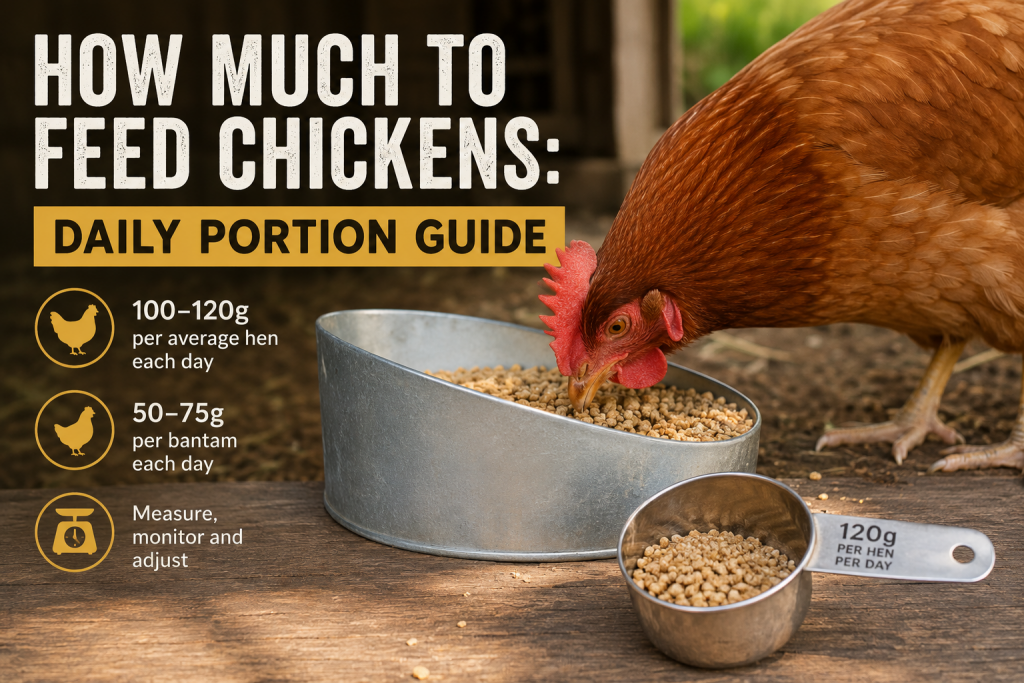
Knowing how much to feed chickens helps you to prevent waste while ensuring every bird receives the right nutrition. As a starting point, allow around 100–120g of complete feed per average adult hen each day. However, as breed size, weather, laying activity and feeder access can all affect consumption, I’ve found the most reliable approach is to measure what your own flock actually eats and adjust the amount gradually.
How much should you feed chickens each day?
Most average adult laying hens eat approximately 100–120g of complete layers feed per day. A hybrid may consume slightly more, around 100–125g, while the smaller bantams need approximately 50–75g.
Typically, you’ll find that large, heavy breeds may eat more than 120g while small hens will need less. These amounts are therefore starting points rather than strict limits.
It’s also important to remember that the figures above apply to healthy adult laying hens. Chicks, growers and non-laying birds need feeds formulated for their particular stage of development. This information is often found on the instructions provided by the feed manufacturer, either printed on the packaging or on their website.
In my experience, complete layers pellets, mash or crumble should form the main part of an adult laying hen’s diet. These feeds contain a carefully balanced combination of energy, protein, vitamins and minerals. Giving your hens more food does not compensate for using the wrong type of feed.
Chicken feed calculator
I use the following simple calculation to help me estimate a flock’s daily requirement:
Number of hens × daily feed per hen = total daily feed
Using 120g per hen gives these approximate amounts:
| Number of hens | Feed per day | Feed per week |
|---|---|---|
| 1 hen | 120g | 840g |
| 2 hens | 240g | 1.68kg |
| 3 hens | 360g | 2.52kg |
| 4 hens | 480g | 3.36kg |
| 5 hens | 600g | 4.2kg |
| 6 hens | 720g | 5.04kg |
| 8 hens | 960g | 6.72kg |
| 10 hens | 1.2kg | 8.4kg |
For example, six average hens eating 120g each will consume approximately 720g per day. Over seven days, they will need just over 5kg.
For a mixed flock, calculate different-sized birds separately. Four standard hens at 120g each and two bantams at 60g each would need an estimated 600g per day:
4 × 120g = 480g
2 × 60g = 120g
Estimated total = 600g
I find these calculations are also helpful in working out how much feed to buy and how long it will last. There’s nothing worse than running short and finding yourself having to dash to the nearest stockist.
Why you should weigh feed rather than use a scoop
Cups, mugs and scoops are convenient, but they are not the most accurate way to measure chicken feed. Pellets, mash and crumble have different densities, so the same container can hold different weights depending on the product.
I always work in grams when checking portion sizes. You only need to weigh the feed carefully while establishing the flock’s normal intake. Once you know how many grams your usual scoop holds, daily feeding becomes much quicker.
However, I would recommend repeating the process whenever you change feed. A scoop containing 120g of one type may hold noticeably more or less of another.
How to measure what your flock actually eats
The amount poured into the feeder is not necessarily the amount eaten by the hens. Some may be thrown onto the ground, damaged by rain or taken by pests and wild birds.
A seven-day feed check provides a much more useful figure.
Begin with the expected daily amount for your flock. Weigh everything placed in the feeder during the following seven days. At the end of the period, weigh any usable feed remaining. Subtract the remaining amount from the total supplied, then divide the result by seven.
For example, suppose you supply 5.5kg during the week and have 500g left:
5.5kg supplied − 500g remaining = 5kg apparently used
5kg ÷ 7 = approximately 714g per day
Next, inspect the feeding area for spilled pellets and signs of rodents or wild birds. If a large quantity is lying beneath the feeder, the hens have not actually eaten the full 714g.
I find this week-long check much more useful than judging portions from a single day. Hen appetite varies, and one unusually hot, cold or disruptive day can produce a misleading result.
Should chickens have measured portions or constant access?
Both methods can work, provided the hens receive enough nutritionally balanced feed and every bird can reach it.
Some keepers supply a measured daily ration. Others use a feeder that holds several days’ feed. I prefer to keep complete feed available throughout the hens’ waking hours while still measuring how much goes into the feeder. This avoids unnecessary restriction but allows unusual changes in consumption to be spotted.
If you provide one measured amount each morning, check that the feeder does not become empty early in the day. An empty feeder by lunchtime may mean the portion is too small, although it can also indicate spillage or pests.
Never reduce the amount sharply because some food remains on one particular evening. Make small changes and observe the flock for several days.
For a broader explanation of layers pellets, mash, crumble and feeding routines, read our guide on How To Feed Chickens.
What changes a hen’s portion size?
The 100–120g guideline suits many hens, but several factors can move consumption above or below this range.
Breed and body size
A large Sussex, Orpington or Brahma generally needs more feed than a small bantam. Body size is one reason fixed portions do not work equally well for every flock.
Different breeds also vary in activity and egg production. A highly productive hybrid may use more nutrients for laying than a less productive bird of a similar size.
Weather
Hens often consume more during prolonged cold conditions because they use additional energy to maintain their body temperature. Natural foraging opportunities may also be reduced during winter.
I always check the feeder more often during cold spells and gradually increase the amount if the usual ration is being eaten consistently and there is no evidence of waste.
Hot weather, by contrast, can reduce appetite and providing fresh drinking water and shade becomes particularly important during these times. Despite the heat, any sudden or severe fall in consumption should not simply be dismissed as weather-related; it could be something health-related that needs checking.
Moulting and laying activity
A laying hen and a moulting hen have different demands on their bodies. When your hens are growing new feathers, they require a little more protein in their diet. I’ve also found that while some moulting hens eat more, others become less active and temporarily eat less. My preference is to continue offering an appropriate complete feed rather than trying to correct the situation with large quantities of extras.
A fall in egg production does not automatically mean the hens need larger portions. Daylight, age, moulting, stress and health can all affect laying.
Free-ranging
Free-ranging hens may find plants, seeds and insects, but the nutritional contribution is difficult to calculate and changes throughout the year.
I would not reduce a flock’s complete feed simply because the hens have access to a large garden. Their normal feed should remain available so they can balance their own intake.
Is the flock eating the feed or wasting it?
A feeder that empties quickly can make it appear that the hens need larger portions. Before adding more, work out where the feed is going.
| What you notice | What it may mean | What to do |
|---|---|---|
| Feeder empty early with little feed on the ground | The ration may be too small | Increase it slightly and monitor for several days |
| Feeder empty with pellets scattered underneath | The feeder is being raked or knocked | Adjust its height or use an anti-waste feeder |
| Feed disappears mainly overnight | Rodents may have access | Remove or securely close the feeder and inspect for signs of pests |
| Feed remains and all hens maintain condition | The ration may be slightly generous | Reduce it gradually rather than making a large cut |
| One hen loses condition while others remain healthy | Competition or illness may be involved | Add another feeding point and examine the affected hen |
| Consumption changes suddenly across the flock | Weather, stress, spoiled feed or illness may be involved | Check the feed, water and birds before changing the ration |
When feed use suddenly increases, I check beneath and behind the feeder before assuming the hens are hungrier. A surprising amount can disappear into bedding or be flicked beyond the immediate feeding area. Anti-waste feeders are a great way to cut down on this.
Raising a feeder to approximately the hens’ back height often reduces scratching and contamination. It must remain low enough for every bird to eat comfortably.
How to make sure every hen gets enough
A flock can receive the correct total amount while one bird still goes hungry.
Dominant hens may guard a feeder or push timid flock members away. This is particularly common following the introduction of new birds or when feeder space is limited.
Watch the flock rather than only checking how much food has disappeared. Every hen should be able to approach, eat and move away without being repeatedly attacked.
Where competition is a problem, provide a second feeding point. Position it far enough away so that one dominant hen cannot control both feeders.
UK welfare guidance states that feeding equipment should minimise the harmful effects of competition and that feed must be accessible to all hens. Although the legal feeder measurements primarily apply to commercial farming, the principle is equally useful for those of us who keep small garden flocks.
How to tell whether a hen is getting enough feed
Do not judge a hen’s nutritional condition by appetite alone. Chickens often appear enthusiastic about food even when they have already eaten enough.
Signs that a bird may not be receiving or absorbing enough nutrition include:
- Progressive weight loss or a breastbone that becomes much more prominent
- Reduced energy, weakness or spending longer away from the flock
- Deteriorating feather condition outside a normal moult
- A sustained fall in food intake
- Being repeatedly prevented from reaching the feeder
- An unexpected reduction in laying alongside other changes
- Persistent frantic feeding despite adequate food being available
These signs do not prove that the flock’s portion is too small. Parasites, digestive problems, infection, bullying and other health conditions can cause similar changes. What is important is to discover the cause. A hen losing weight despite having access to plenty of appropriate feed needs closer examination. Seek advice from a poultry-friendly vet if weight loss continues or the bird shows other signs of illness.
How much feed should you buy?
A 20kg bag provides approximately 166 portions of 120g. Its expected lifespan depends on flock size:
| Flock size | Approximate life of a 20kg bag |
|---|---|
| 2 hens | 83 days |
| 3 hens | 55 days |
| 4 hens | 41 days |
| 5 hens | 33 days |
| 6 hens | 27 days |
| 8 hens | 20 days |
| 10 hens | 16 days |
These figures assume the feed is eaten rather than spilt or taken by pests.
While buying larger bags can be more economical, this only works if the food doesn’t go off before you use it all. While layers pellets can last for up to six months when stored in a dry, secure container, the nutritional value degrades after two to three months. Always check its best-before date and follow the manufacturer’s storage instructions.
Do treats count towards the daily portion?
Treats count towards to a hen’s total intake. This means they should not simply be added on top of the full daily allowance in unlimited amounts.
The British Hen Welfare Trust recommends limiting treats to no more than approximately one dessertspoonful from each hen’s daily food allowance. This helps prevent supplementary foods from replacing the balanced nutrition supplied by complete layers feed.
If I give treats, I always offer the main feed first, particularly during the morning when hens are hungry. An otherwise healthy hen that fills up on extras may eat less of the food formulated to support her health and egg production.
Key takeaways
- Allow around 100–120g of complete feed per average adult hen each day
- Use approximately 50–75g as a starting point for many bantams
- Calculate portions by weight rather than by cups or scoops
- Measure consumption over seven days before making major adjustments
- Check for spillage, rodents and wild birds when feed disappears unusually quickly
- Keep complete feed available even when hens are free-ranging
- Provide additional feeding points if lower-ranking hens are being excluded
- Investigate sudden appetite or weight changes rather than assuming the portion is wrong
Getting chicken portions right
Start with 100–120g per average hen, then use your flock’s actual consumption and body condition to refine the amount. Small adjustments are more reliable than repeatedly filling an empty feeder without checking for waste. Once you know how much the hens genuinely eat, ordering feed and spotting unusual changes become much easier.
See Seasonal Feeding For Chickens for practical advice on adjusting your feeding routine throughout the year.
Source note: Portion figures and welfare guidance in this article have been checked against information from Chicken Vet, the British Hen Welfare Trust and the GOV.UK Code of Practice for the Welfare of Laying Hens and Pullets.
Disclosure: As an Amazon Associate I earn from qualifying purchases. This post may also contain affiliate links from other retailers. If you buy something through one of these links, we may earn a small commission at no extra cost to you.

Kevin O’Hara got his first chickens back in 1972. A backyard chicken keeper based in Yorkshire, he created of KeepingChickens.uk back in 2012. With years of hands-on experience, he shares practical, UK-specific advice to help others care for happy, healthy hens. Learn more about Kevin on the author page.